
Colorado Parole Hearing Releases
Colorado parole hearings belong to the state prison and parole system. They explain potential release from CDOC prison custody to parole supervision, not routine release from the Hinsdale County Jail on bond, time served, or a local court order. The Colorado State Board of Parole is the board name. CDOC publishes a parole board calendar link through the offender-search interface. For a person connected to Hinsdale County, the parole path matters when the person is a state prisoner, a parolee facing revocation, or someone whose county case led to state custody.
A parole hearing does not always mean release. The outcome can be granted parole, deferred or denied parole, rescinded parole, revoked parole, continued parole, mandatory release to parole, or discharge in a different record context. Eligibility also does not guarantee release. Colorado law and parole board discretion shape the result. The exact outcome must come from Board, CDOC, or court records rather than from a release date alone.
Confirm a Colorado Parole Release
The CDOC parole board calendar displays calendar months and schedule entries. The research captured current and future months in July through November 2026, with future months available after scheduling was set. The page says users can hover over a date to pull up that day's schedule and click a calendar title to view a larger calendar. It also warns that hearings and schedules are subject to change and that DOC modifications appear the following business day.
- Search CDOC offender records first to confirm the person is a state offender or parolee.
- Use the parole board calendar to identify scheduled application, rescission, or revocation hearings.
- Preserve the date, hearing type, and any status shown by the calendar.
- Use CDOC offender-search date fields after the hearing to check parole, release, or discharge status.
- Contact the case manager or jail contact required by the calendar page before attending a hearing.
For individual release confirmation, no separate modern statewide decisions-result database was located beyond the hearing calendar interface and historical parole materials referenced in research. Use CDOC offender status, Board hearing records, and supervision records rather than promising a simple decision lookup.
Parole Board Attendance Rules
The calendar page states that all parole board hearings are open for public attendance, but advance arrangements are required. The route depends on the hearing type. For application hearings or rescission hearings, attendance is coordinated through the offender's case manager. For revocation hearings, attendance is coordinated through the jail where the offender is located. This matters in a Hinsdale County context because a parolee held locally on a revocation matter may involve both a jail contact and the State Board of Parole.
Colorado State Board of Parole Calendar
Published through CDOC offender search
Calendar: https://www.doc.state.co.us/oss/index.php?ref=pblist
CDOC main phone: 719-579-9580
CDOC email: cdoc@state.co.us
Public attendance: advance arrangements required
The Board calendar is a scheduling source. It is not the same as a county jail release list. If the person was released from Hinsdale County Jail on a local court order, the courthouse and HCSO records are the sources. If the person was in CDOC custody, the Board calendar can explain the hearing event and CDOC can show resulting parole or release status.
Colorado Parole Outcomes
Parole terms should be used with care. A grant of parole is a Board decision allowing release to parole supervision. A deferral or denial means release was not granted at that hearing. A rescission can take back a previously granted release before it takes effect. A revocation can return a person to custody after a violation process. Mandatory release to parole is different from discretionary release, and discharge is different from parole. A parolee is released from prison, but not necessarily off supervision.
- Parole
- Release from prison custody to state supervision under conditions.
- Revocation
- A process that can return a parolee to custody after a violation finding.
- Mandatory release
- A parole-release date over which the Board has no discretion under Colorado rules.
- Discharge
- Completion of the sentence or supervision term shown in the record.
Colorado Parole Calendar
The manifest includes a screenshot from the Colorado Parole Board schedule page. It fits this page because the calendar is the documented state source for hearing schedule checks, date changes, and attendance routing.
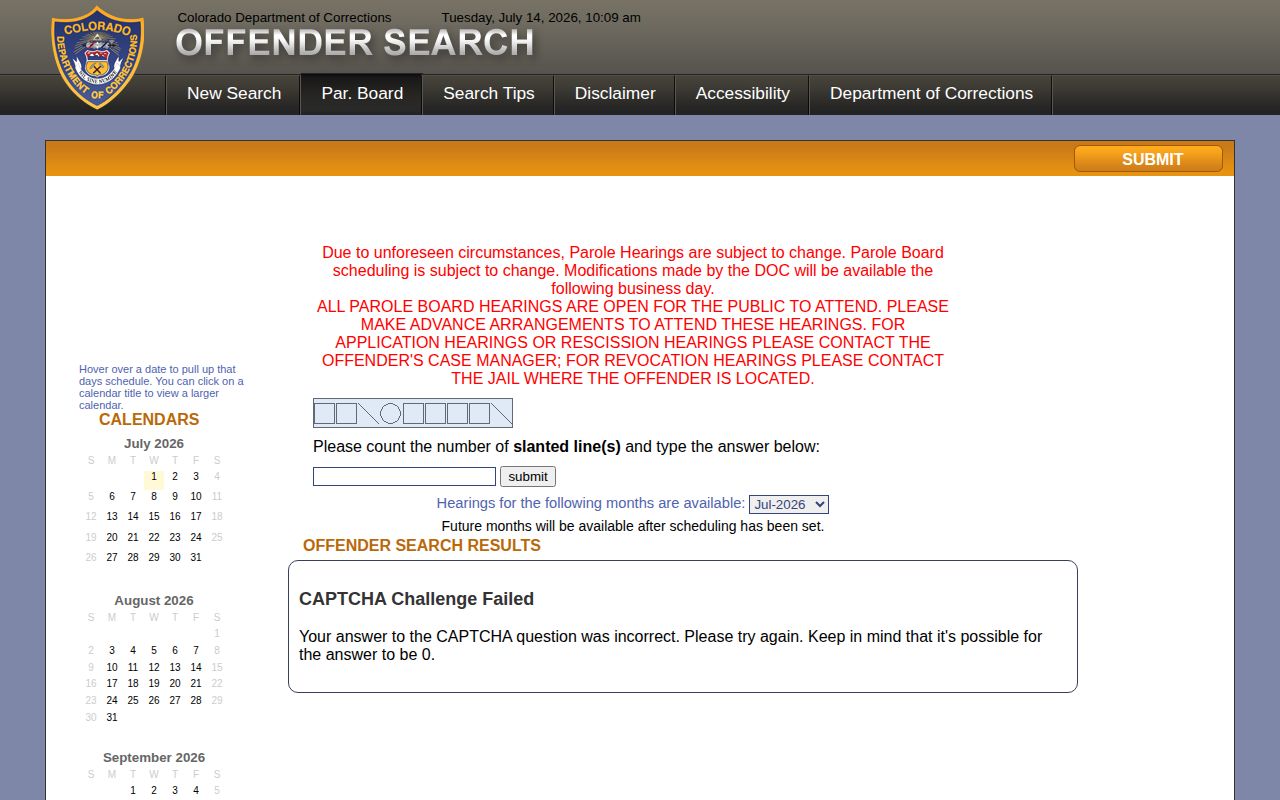
The calendar helps identify the hearing event; CDOC offender records and parole supervision records help confirm what happened after that event.
Colorado Parole Eligibility Rules
Colorado parole eligibility law affects when a hearing or release opportunity can arise. Section 17-22.5-303.3 contains special rules for listed violent offenses, including an eighty-five-percent rule for listed offenses committed on or after January 1, 2025. Section 17-22.5-405 covers earned time, which may affect projected dates when progress is demonstrated and certified. Section 17-2-201 addresses Board duties and parole discretion. Together, these sources explain why two state prisoners with similar sentence lengths may not have the same parole path.
Those statutes should not be applied to a local Hinsdale County Jail bond release. A county release date can be controlled by bond, court order, time served, hold release, or transfer. A state parole hearing applies after CDOC custody or parole jurisdiction exists. When the custody type is unclear, start with the Hinsdale County released inmates search path and then move to the correct system.
Note: Parole eligibility is not the same as release; the Board process and the record outcome still control the result.
Hinsdale Parole Hearing Fit
Parole hearings matter for Hinsdale County only when the person is in the state-prison or parole system. They do not explain a local booking release by themselves. If the HCSO record says bond, personal recognizance, time served, or warrant recall, the parole calendar is probably the wrong source. If the HCSO record says transfer to CDOC, or if the person is already a CDOC offender, the calendar can help explain whether a release was tied to a Board event.
A parolee arrested in Hinsdale County may create a mixed record. HCSO may hold the person locally, the court may have a local case or warrant entry, and the parole system may handle a revocation or re-release decision. In that setting, do not collapse all events into one "release." Track the jail release, the parole hearing, and the CDOC status as separate records until the dates and labels line up.
The same rule applies to public attendance. A family member or case participant should not assume the Lake City courthouse or sheriff office can arrange a state parole hearing. The calendar source routes application and rescission hearing attendance through the offender's case manager, and revocation hearing attendance through the jail where the offender is located. That routing should be checked before travel or scheduling plans.
Public Record Search
Sponsored Results